Values are often described as who we are and how we do things around here.
Yet in many organizations, values live on walls, websites, posters or slide decks while employees experience something very different in their day-to-day work.
At Inner Strength Communication Inc., we’ve seen this pattern repeatedly across sectors:
leaders believe values are clear and well-communicated, while employees and clients experience confusion, inconsistency, or even contradiction.
The issue is not the values themselves. The issue is how values are experienced differently by different audiences and whether internal communication intentionally bridges those experiences.
Values Are Not Interpreted Equally
One of the most important insights from our work in internal communication strategy, employee engagement, and employee experience design is this:
People experience values through the lens of their role.
The same value—respect, care, accountability, trust—can feel strong and alive to one group, and invisible to another.
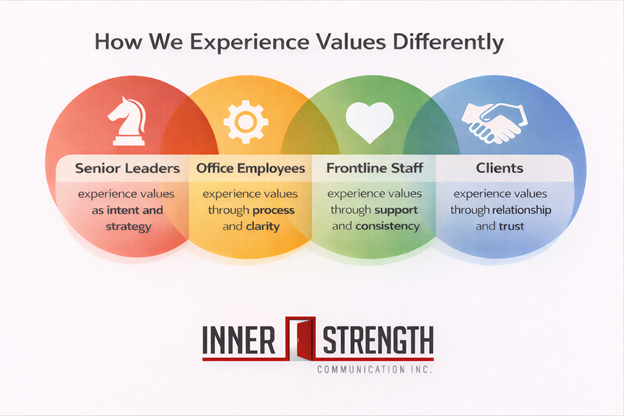
Senior Leaders Experience Values as Intent and Strategy
For senior leaders, values often live at the strategic level.
They experience values through:
- Vision and purpose
- Strategic plans and priorities
- Decisions made at the board or executive table
- Language used in speeches, town halls, and leadership messaging
From this vantage point, values feel aspirational and directional. Leaders believe they are setting the tone and trusting the organization to carry it forward.
This is where internal communication plays a critical role:
- Translating strategic intent into clear meaning
- Connecting values to decisions and trade-offs
- Ensuring leaders are seen living the values, not just naming them
Without that connection, values remain abstract—clear at the top, blurry everywhere else.
Office Employees Experience Values Through Process and Clarity
Office-based employees experience values much more practically.
They feel values through:
- Policies and procedures
- Decision-making processes
- Role clarity and expectations
- How work gets approved, prioritized, or delayed
For this group, values are not what leaders say, they’re what systems allow.
When processes are confusing or inconsistent, employees often conclude:
“These values sound good, but they don’t guide how things actually work.”
Strong internal communication ensures:
- Processes are explained, not assumed
- Values are reflected in workflows and governance
- Employees understand why decisions are made, not just what was decided
This clarity is foundational to employee engagement and trust.
Frontline Staff Experience Values Through Support and Consistency
Frontline employees experience values most viscerally.
They feel values through:
- Day-to-day leadership behaviours
- Access to support, tools, and resources
- Fairness and consistency in expectations
- How issues are handled when things go wrong
For frontline teams, values are personal. They show up in moments of pressure, safety, care, and recognition.
If communication is inconsistent, or support varies by manager, values quickly lose credibility.
Effective internal communication and employee experience design focus on:
- Equipping managers to communicate consistently
- Reinforcing expectations through coaching and feedback
- Making “how we treat people” visible and non-negotiable
This is where values stop being words and start becoming culture.
Clients Experience Values Through Relationship and Trust
Clients don’t read internal value statements. They experience values through relationships.
They feel values through:
- Consistency of service
- Empathy and responsiveness
- Follow-through on commitments
- Trust built over time
If internal communication is misaligned, clients often feel it first, through mixed messages, service breakdowns, or uneven experiences.
This is why employee engagement and employee experience directly affect customer experience.
When values are clearly communicated internally and lived consistently:
- Employees show up with confidence and care
- Relationships strengthen
- Trust grows organically
Values become a promise kept, not a slogan shared.
Why Internal Communication Is the Thread That Connects It All
Values don’t fail because organizations choose the wrong words.
They fail because internal communication doesn’t intentionally connect experience across audiences.
Strong internal communication:
- Connects strategy to behaviour
- Aligns process with purpose
- Reinforces consistency and care
- Builds trust internally and externally
This is the work of strategic internal communication and employee engagement consultants who ensure we don’t not launch campaigns and walk away. Instead, we focus on embedding values into how the organization operates every day.
From Words to Ways of Working
At Inner Strength, our Inside-Out approach helps organizations move values:
- From Discovery (listening and understanding lived experience)
- To Decision (clarifying what values truly mean in practice)
- To Direction (embedding values across the employee lifecycle)
Because values only matter when people can feel them, see them, and trust them, no matter where they sit in the organization.
Looking to Strengthen Values, Engagement, and Experience?
If your organization is:
- Revisiting or refreshing its values
- Experiencing gaps between leadership intent and employee experience
- Looking to improve employee engagement, trust, and alignment
- Searching for internal communication, employee engagement, or employee experience consultants
We’d love to help. Inner Strength Communication Inc. works with organizations to turn values into lived experiences building clarity, consistency, and connection from the inside out.